阿摩線上測驗
登入
首頁
>
教甄◆英文科
>
111年 - 新竹市建功高中國中部英文科教師甄試試題(1-35)#108219
> 申論題
題組內容
Question 3 (15%)
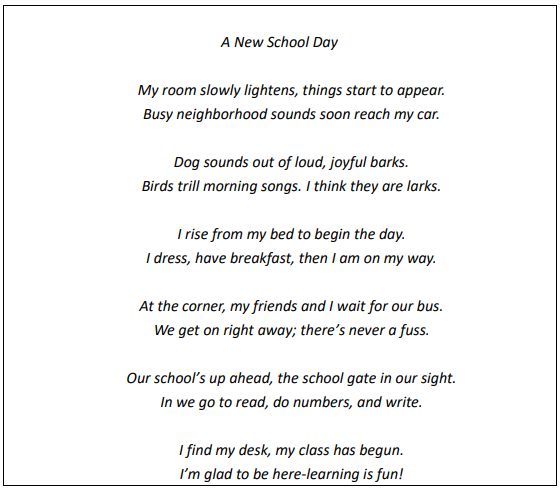
Here is an article “ A New School Day.” Suppose it is the content of the textbook for the 8th grade.
Task:
2) Explain how you design the worksheet. What elements do you include? What elements do not you include? Why? (5%)
相關申論題
IV. Essay questions: 50% in total Question 1 (20%) If students refuse to follow the rules or participate in the activities in class, how do you handle the conflict with students in class? What is your principle in classroom management? (10%) Think of one situation that may happen in a junior high school classroom and your solution to it. (10%)
#464371
Question 2 (15%) Below is an article for your future students. Please utilize it to develop a 50-minute lesson plan, including teaching procedures, teaching resources, and the time spent. In your assigned tasks or activities, you need to consider students’ differentiated levels of English.
#464372
1) Design a worksheet as a formative assessment. The worksheet should meet diverse students’ need. (10%)
#464373
Q4. Writing Assessment (20%)Below is an English composition written by a 12th grader. (1) Use a table to mark each error in the composition and provide every corresponding written corrective feedback to improve its accuracy,clarity, and coherence. (2) Provide an overall suggestion after making corrections. Note that your feedback should be specific enough (but not too overwhelming) to help the student know how to improve their writing. Provide some writing strategies appropriate for this student說明:1.依提示在「答案卷」上寫一篇英文作文。2.文長至少120個單詞(words)提示:排隊雖是生活中常有的經驗,但我們也常看到民眾因一時好奇或基於嘗鮮心理而出現大排長龍(form a long line)的現象,例如景點初次開放或媒體介紹某家美食餐廳後,人們便蜂擁而至。請以此種一窩蜂式的「排隊現象」為題,寫一篇英文作文。第一段,以個人、親友的經驗或報導所聞為例,試描述這種排隊情形;第二段,說明自己對此現象的心得或感想。My friend, Mina, and I have a sweet tooth, Last week, we heard from a TV commercial that a famous bakery had opened a branch in our neighborhood. There, a special kind of cream puff is sold and said to have been incredibly delicious. We were so excited that we had no choice but scream out. Out of curiosity, we decided to go and see. However, as we approched the bakery, a long line extending to the block has already formed. We wanted to give up, but we couldn't fightthe lure of the mouth-watering picture of the cream puff. So we waited in the line. Some people were staring at their phone to pass time, others seemed restless and lack of patience, complaining about the wait. Inspite of the long wait, we believed the cream puff is worth it. Time passed by, the line moved very slowly, and the sun was getting hotter. Not until an hour later that I finally reached to the front. However, just as I was about to order, the staff announced that the cream puffs weresold out. Some customers sighed with disappoint, and others, just like Mia and I, were simply left quietly. "It's not fair,we've beenwaiting for over an hour!"Mia murmured. The result iswe waited for nothing, which made us look silly.This frustrating experience made me realize that sometimes people just follow the crowd without second thought. Maybe some in the line had no interest in the cream puffs but just because they saw others doing the same. In the end, we couldn't help wondering was it worth spending so much time for a small dessert? In my opinion, if I knew the cream puffs were limited, I would go to the bakery earlier. However, Mia had said she would definitely not line up for anything, even if it is her favorite dessert!
#564190
Q3. Lesson Plan Design (30%) Please design a 4-period English-as-a-medium-of-instruction (EMI) lesson plan based on Irena Sendler: A Holocaust Hero (see the text below) for 11th graders at Kaohsiung Girls' Senior High School to enhance their language skills, creativity, and criticality. Describe how you leverage two important pedagogical approaches, including translanguaging and multimodality, and integrate other historical events with the story of Irena Sendler, focusing on language practice and historical comparison. Please elaborate on specific teaching objectives, tasks, teaching materials and assessment methods. Irena Sendler: A Holocaust Hero It was the early morning of October 20, 1943, and eleven German Gestapo* agents had just burst through the front door of a Polish* woman's apartment. They searched her home from top to bottom, tearing open every pillow and mattress*. If they had entered just seconds earlier, they would have found the precious list before the woman slipped³ it to her friend. After three hours of searching, they gave up and arrested the woman. Knowing the list was safe, she breathed a sigh of relief. The young lady was Irena Sendler, a compassionate social worker who lived in Warsaw*, Poland. During World War II, the Nazis* seized7 control of this city and announced the establishment of the Warsaw Ghetto*. Over 400, 000 Jews* were herded into this area, and thousands of them were dying from starvation8 and disease every month. Horrified by these shocking conditions, Irena decided to join an underground resistance group and began helping to bring in food and medicine to the Jews secretly. However, she soon realized this would not be enough, as the ghetto was sealed9 and the Nazis had already started sending Jews to death camps. Determined to help, Irena recruited¹0 her friends and colleagues¹1! for a risky mission: sneaking12 Jewish children out ofthe ghetto. To enter the isolated area, they managed to obtain 13 official passes. Once inside, they faced an even bigger challenge: convincing14 Jewish parents to hand their children over to strangers. In the end, many parents made the heart-wrenching* decision in hopes that their children could survive even if they themselves couldn't. Hidden in everything from suitcases15 to flour sacks¹6, the children were smuggled¹7 out in various ways. One ambulance¹8 driver even hid babies under stretchers* and trained his dog to bark in order to drown out their cries. Irena and the other courageous¹9 people were risking their own lives. Once caught, these compassionate smugglers and their families would certainly facé execution20. After successfully escaping, the children were given new identities, complete with fake2¹ birth documents22 and family records. Some were taken in by kind and brave Polish families, while others were sent to orphanages* or convents*. Irena hoped that after the war the children could be reunited with their parents, so she kept detailed records. Her list included each child's real name, his or her new identity, location, and parents' names. Unfortunately, at the height of this rescue operation, Irena was arrested for her underground work. Despite being brutally tortured, she refused to reveal any information. She chose to sacrifice her own life instead of putting the lives of others at risk. Eventually, Irena was rescued by her friends and continued to work to save Jewish children while living in hiding. If Irena and her friends had not helped, over 2,000 children would have ended up in the death camps. To this day, Irena Sendler is still remembered for her selfless acts during the Holocaust. While she never admitted23 it, she was a true hero who risked her life to save others, and her story of bravery24 and compassion continues to inspire people all over the world.-Written by Kelsi Wright
#564189
2.Based on your own passage, design FIVE cloze test questions suitable for 12th graders at KGHS. Each question should have 4 answer choices, with the correct answer underlined. (15%)(A) On April 6, U.S. President Donald Trump, speaking aboard Air Force One, emphasized that foreign governments would need to pay "a lot of money" to have the tariffs he imposed lifted, referring to them as necessary "medicine." This stance has triggered significant turmoil in global financial markets, with sharp declines in Asian stocks and a drop in U.S. stock futures. Investors are concerned about the potential for higher prices, reduced demand, and an impending global recession. Despite these market setbacks, Trump remained unfazed, asserting that sometimes economic pain is needed to address deeper issues. Trump's recent tariff announcement, which could impose levies as high as 50%, has sparked retaliatory actions from countries like China, raising fears of a global trade war. While Trump indicated that he had spoken with European and Asian leaders, he made it clear that negotiations would not take place unless they agreed to pay the U.S. substantial sums annually. In response, Taiwan's President Lai Ching-Te proposed zero tariffs as a basis for talks, promising to eliminate trade barriers and boost Taiwanese investment in the U.S. Other countries, including Israel, India, and Italy, have also expressed interest in negotiating with the U.S. to avoid the tariffs, with some leaders meeting Trump to seek exemptions or temporary reprieves.This situation has created uncertainty about whether the tariffs are intended as a permanent measure or part of a broader strategy to gain leverage in trade negotiations. (B) On April 7, Asian stock markets experienced sharp declines, with major indices like the Shanghai Composite, Hong Kong's Hang Seng, and Japan's Nikkei 225 plunging to levels not seen in decades, following U.S. President Donald Trump's tariff announcement. The Shanghai Composite fell by more than 8%, while Taiwan's Weighted Index dropped 9.7%, marking its largest single-day loss ever. Hong Kong's Hang Seng also saw a significant 13.2% decline, and Japan's Nikkei suffered substantial losses. These drops were driven by Trump's new tariffs, ranging from 10% to 46%, on imports from various countries, severely impacting manufacturing hubs in Asia that rely heavily on the U.S. market.Countries such as Japan, South Korea, Vietnam, and China face hefty tariff increases, with Vietnam seeing a 46% levy. Taiwan, in particular, was hit hard, with a 9.7% drop in its index, compounded by the broader market downturn. The tariffs have sparked fears of a global trade war, potentially pushing the U.S. into a recession and further damaging Asian exports. Economists have raised the likelihood of a U.S. recession, with Goldman Sachs now estimating a 45% chance. Many Asian nations, including Vietnam and Bangladesh, are highly dependent on U.S. exports, and these tariffs are expected to disproportionately hurt their economies. Overall, the turmoil in global stock markets, compounded by retaliatory tariffs from China and other nations, has wiped out trillions in value, leaving the economic outlook uncertain.
#564188
1.Read the following two passages, ( A ) and ( B ), and rewrite a passage of approximately 200 words.
#564187
Q1. Reading Comprehension Design (25%) Read the following passage and create FIVE reading comprehension questions that align with the current Integrated Reading Comprehension (混合題) format. The first two questions should focus on identifying the main idea and making inferences. Ensure that the five questions include at least three different question types, such as multiple-choice, matching, ordering, fill-in-the-blank, completing-the-form/table/ chart, or short-answer. Finally, provide the correct answer for each question. The practice of fastening papers dates back to the 13th century, when ribbons were threaded through slits in the top-left corners of documents. These ribbons were often waxed to improve durability and allow reuse a technique that remained in use for centuries. In 1835, John Ireland Howe, a physician from New York, revolutionized the process by inventing a machine that massproduced straight pins. Though originally designed for sewing, these pins were repurposed as a convenient way to fasten papers. The modern paperclip, however, is credited to Johan Vaaler, a Norwegian inventor with expertise in electronics, science, and mathematics. In 1899, he patented a bent-wire paperclip design in Germany, since Norway lacked a patent system at the time. A U.S. patent followed in 1901. Although similar designs may have predated his, Vaaler was the first to secure official recognition.Around the same time, American inventor Cornelius J. Brosnan patented his version, known as the "Konaclip." However, it was the British company Gem Manufacturing Ltd. that introduced the now-iconic double-oval paperclip, known as the "Gem" clip. In 1899, William Middlebrook of Connecticut patented a machine to mass-produce these clips, though the design itself was never patented. Over time, many variations emerged, including the "non-skid" clip for better grip, the "ideal" clip for thicker stacks ofpaper, and the "owl clip, designed to resist tangling. During World War II, the paperclip took on symbolic significance in Norway. When Nazi authorities banned displays of loyalty to the Norwegian king, citizens began wearing paperclips on their clothing as a discreet sign of unity and resistance-an act that carried the risk of arrest. Beyond organizing paper, paperclips are surprisingly versatile. Their flexible metal construction makes them useful for a variety of impromptu tasks, such as ejecting CD trays, accessing SIM card slots, or even serving as makeshift lock picks.
#564186
(2) Promoting Peer Learning Through Positive Role Modeling:(5%)Explain how you make use of these students’ learning processes and outcomes as positive examples for the rest of the class. How do you provide purposeful learning activities while fostering a learning environment that encourages collaboration, mutual respect, and academic growth for all students?
#564185
(1) Identifying and Supporting Students with Advanced Performance:(5%)Describe how you identify students who demonstrate advanced proficiency in English. Based on their individual strengths, how do you provide appropriate resources and learning opportunities to help them continually deepen their language skills and sustain steady progress?
#564184
相關試卷
115年 - 115-1 國立陽明交大附中_教師甄選試題:英文科#137722
115年 · #137722
114年 - 114 高雄市立高雄女子高級中學_教師甄試試題:英文#137729
114年 · #137729
114年 - 114-2 國立屏科實驗高級中等學校_專任教師甄選國中部教師初試試題:英文科#137728
114年 · #137728
114年 - 114-1 國立基隆高級中學_教師甄選試題:英文科#137695
114年 · #137695
114年 - 114 文藻外語大學_國小教師教育學程新生甄選試題:英文#130723
114年 · #130723
114年 - 114 高雄市市立國民中學教師聯合甄選:英語#129012
114年 · #129012
114年 - 114-2 新竹市國民中學教師聯合甄選初試試題:英文科#128195
114年 · #128195
114年 - 114 臺南市市立國民中學_正式教師聯合甄選試題:英語文專門科目#128067
114年 · #128067
114年 - 114 桃園市國民中學新進教師聯合甄選試題:英語文科#127823
114年 · #127823
114年 - 114 中區縣市政府教師甄選策略聯盟:國小英語#127532
114年 · #127532
 Task: Task:
 阿摩線上測驗
登入
Task:
阿摩線上測驗
登入
Task: