阿摩線上測驗
登入
首頁
>
研究所、轉學考(插大)-物化分析
>
109年 - 109 國立台灣大學_碩士班招生考試:物化分析#90697
> 申論題
題組內容
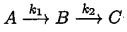
14. (10 pts) Given the reaction mechanism in which the two steps are both the frst order reactions.
(a) (2 pts) Write down the rate laws for d A(t)]/dt and d[B(t)]/dt.
相關申論題
(A) A) is the mass spectrum of a 3-heptanone sample obtained under positive ion mode showing the protonated molecular species [MH]+ with a major peak at 114 + 1 ~ 115 (m/z). This 3-hetpanone sample is chromatographically pure with only a single peak on HPLC. Why does it have a small peak at 116 (m/z) on the mass spectrum? (4%)
#371331
(B)B) is the mass spectrum of an unknown organic molecule obtained under positive ion mode. Estimate the number of protons associated with this ion and the mono-isotopic mass of this molecule. Show your work. (3%)
#371332
(A) A) is the 1H NMR spectrum of 3-hetanone. Hydrogens associated with each carbon are labeled in the molecular structure shown below. Assigned each group of peaks from left to right on the NMR spectrum with lower-case letters (a-f). (4%)
#371333
(B) Homonuclear decoupling is a technique where the sample to be analyzed is irradiated at a select frequency to eliminate the effect of coupling due to certain nuclei. In other words, the signal of a select nucleus can be selectively saturated, such that this nucleus can no longer couple to neighboring nuciei. This technique helps to simplify complicated peak splitting. Irradiation at which group of protons (a-f) would result in spectral simplification in the 2.3 - 2.6 ppm range as shown in B)? Use the same lower-case letter(s) notation in A). (3%)
#371334
(a) (8 pts) Integrate the first and the second laws Tds = dU + PdV - μdn, together with the above conditions (a)(b)(c), to obtain the entropy formula S(U, V,n), which is a function of U,V and n (and T, P, μ are all eliminated).
#371335
(b) (4 pts) Suppose that a slightly different gas system satisfies (a') U= nCTδ but not (a), where the constant δ ≠1. Show that the conditions (a')(b)(C) imply that the entropy change dS is not an exact differential.
#371336
(c) (8 pts) Modify the above chemical potential expression (c) into your (c), so that (a')(b)(c') make dS an exact differential. Obtain the entropy expression S(U,V,n) from (a')(b)(c').
#371337
(b) (3 pts) Initially [A(t = 0)] = A0, and [B(t = O) = [C(t = 0)] = 0. Apply the steady state approximation on the intermediate B, to solve the product concentration [C(t)].
#371339
(c) (5 pts) Without using the steady state approximation, solve the concentra- tion [C(t)] exactly from the rate laws. What is the condition under which the steady state approximation applies?
#371340
(a) (2 pts) Show that the hamiltonian is hermitian.
#371341
相關試卷
110年 - [無官方正解]110 國立臺灣大學_碩士班招生考試_化學研究所化學組:物化分析#129041
110年 · #129041
109年 - 109 國立台灣大學_碩士班招生考試:物化分析#90697
109年 · #90697
 阿摩線上測驗
登入
阿摩線上測驗
登入